Recently, Associate Researcher Li Teng from our laboratory’s ocean color satellite remote sensing team and collaborators have made new progress in the remote sensing detection of vertical profiles of water inherent optical properties and regional biogeochemical applications. Relevant findings were published in IEEE Transactions on Geoscience and Remote Sensing and Geophysical Research Letters.
This study developed a satellite remote sensing retrieval method for the vertical profile of particle beam attenuation coefficient (cp660) in waters shallower than 125 m in the South China Sea. Based on this method and in-situ measured particulate organic carbon (POC) data, a 3D dataset of POC in the upper South China Sea waters from 2003 to 2023 was generated. The team further evaluated the impacts of profile structure (profile concentration and integrated depth) on POC stock estimation, as well as the contributions of primary production and POC stock variations to POC export, expanding the previous research perspective that mainly focused on primary production-driven POC export.
The biological pump constitutes a critical component of the marine carbon cycle by converting inorganic carbon in seawater into organic carbon and exporting it downward to the deep ocean in the form of particulate organic carbon (POC) for sequestration. Although phytoplankton in the euphotic zone account for only approximately 0.2–0.3% of marine biomass, their high turnover rate enables the biological pump to regulate roughly 70% of the vertical gradient changes in dissolved inorganic carbon at the global scale. Therefore, a fundamental focus of climate change research is to improve the understanding of POC distribution, composition, and variations under diverse climatic conditions within the euphotic zone.
However, as a major platform for large-scale and continuous observation of marine POC at global or regional scales, ocean color satellites theoretically provide information limited to the first optical depth (i.e., the upper 20% of the euphotic zone). It is therefore urgent to enhance the capability of current ocean color satellite remote sensing in observing the vertical profile distribution of POC across the entire euphotic zone, so as to strengthen the value of ocean color remote sensing for marine monitoring and subsequent climate change analysis.
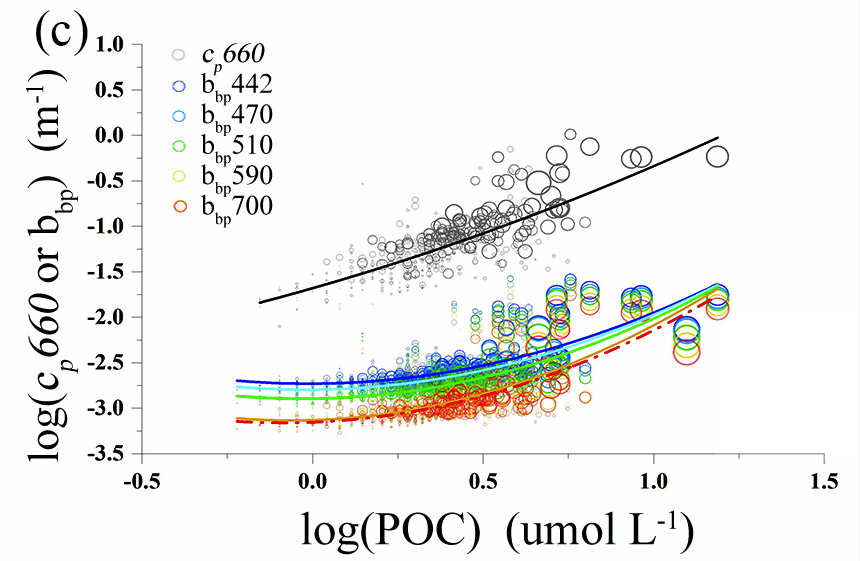
To address the above challenges and demands, the research team analyzed the capability of different water optical properties in characterizing POC. Results show that when only considering the particle backscattering coefficient (bbp), bbp in the yellow-red bands is more sensitive to POC variations in the study area than that in the blue-green bands on an annual scale (with a steeper slope of bbp variation with POC). When POC concentration is below 0.25 μmol L⁻¹, bbp becomes insensitive to changes in POC concentration and remains at a fixed background value (varying with wavelength).
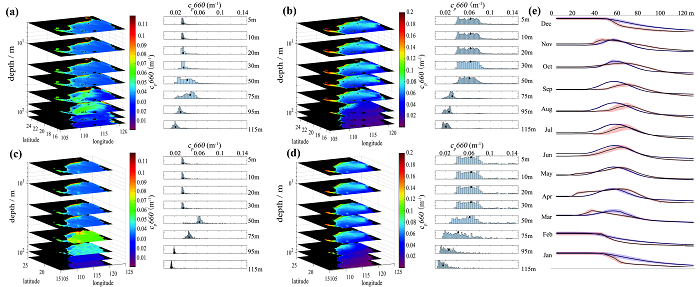
In contrast, the particle beam attenuation coefficient (cp660) is more suitable as a proxy for POC in the study area, maintaining a robust covariance with POC even at concentrations below 0.25 μmol L⁻¹. Combining field survey data and analytical results, the team further established an ocean color satellite remote sensing retrieval method for the cp660 profile in the upper South China Sea waters, realizing the dynamic observation of cp660 vertical profiles in the study area with an accuracy within 35%.
By analyzing the conversion relationship between cp660 and POC in the study area, the team generated a monthly 3D POC dataset covering 2003–2023. On this basis, the spatiotemporal variation characteristics and controlling factors of POC stock in the South China Sea were analyzed.
Results indicate that at the regional monthly scale, the mean POC in the euphotic zone and 100 m water column is closely correlated with sea surface POC (R>0.9). For the fixed 100 m water column, POC stock changes are determined by vertical POC concentration, showing an overall decline from 2003 to 2023. For euphotic zone POC stock, the integrated depth (i.e., euphotic zone depth) dominates its seasonal and interannual variations, which instead shows an upward trend from 2003 to 2023 due to the increase in integrated depth.
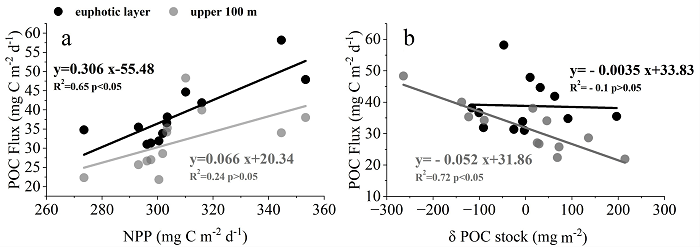
Given the significant changes in POC stock in the study area, the team used a food web model under the assumption of mass balance to analyze the impacts of primary production and POC stock variations on POC export. Results show that primary production is the main source of POC export at the euphotic zone depth, while the contribution of POC stock variation cannot be neglected for the 100 m depth commonly used in field observations.
Fig.1 Variation analysis of water inherent optical properties (bbp and cp660) and POC in the study area.
Fig.2 Remote sensing retrieval results of cp660 vertical profiles.
Fig.3 Correlation analysis between POC export, net primary production (NPP) and POC stock variation.
References
[1] Li T., Bai Y., Cui W., He X., Pan T., Tao B., Zhang X., Yin Z. (2025). Characterizing the 3-D Structure of Particle Beam Attenuation Coefficient in the Northern South China Sea.
IEEE Transactions on Geoscience and Remote Sensing, 63, 1-19.
https://doi.org/10.1109/TGRS.2025.3581197
[2] Li, T., Bai, Y., He, X., Tao, B., Zhang, X., Gong, F., et al. (2025). Variability of particulate organic carbon stock in the South China Sea with reference to profile structures.
Geophysical Research Letters, 52, e2025GL119155.
https://doi.org/10.1029/2025GL119155