Recently, Researcher He Xianqiang and his collaborators published a paper entitled Estimation of sea surface foam coverage and effective foam layer thickness from satellite microwave measurements in the journal Remote Sensing of Environment. The first author is Associate Researcher Jin Xuchen, and the corresponding author is Researcher He Xianqiang. Co-authors include Academician Pan Delu, Researcher Bai Yan, Professor-level Senior Engineer Zhu Qiankun, Senior Engineer Ying Jianyun, Dr. Zhao Yaqi, and Professor Palanisamy Shanmugam from the Indian Institute of Technology Madras.
Generated by breaking ocean waves and filled with numerous air bubbles, sea surface foam acts as a critical regulator for momentum, heat and gas exchange across the air-sea interface. Meanwhile, it can significantly alter the microwave radiation characteristics of the sea surface, serving as one major source of uncertainty in marine parameter retrieval via microwave remote sensing. For a long time, sea surface foam coverage can be estimated through various observation means and numerical models. Nevertheless, restricted by scarce experimental data and empirical parameterization limitations, there are still no mature models and observational constraints applicable to global operational retrieval of foam layer thickness.
To solve the above challenges, this study puts forward a new joint retrieval method using dual-channel passive microwave remote sensing at L-band and Ka-band. Combining multi-source satellite microwave brightness temperature observations from Aquarius, SMAP, WindSat and other missions, this research establishes a physical conversion and separation process from top-of-atmosphere brightness temperature to sea surface foam radiative components, and further derives the quantitative relationship between sea surface foam coverage, effective foam layer thickness and wind speed, as well as their global spatial distribution patterns.
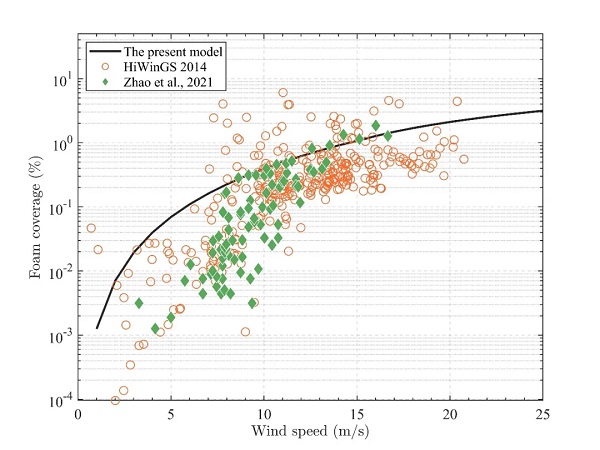
Validation results show that the retrieved foam coverage is in great consistency with independent observational data, proving the excellent robustness of this method across different observation systems. In addition, the retrieved effective foam layer thickness increases with rising wind speed, which is generally consistent with existing hydrodynamic parameterization results. This proposed approach provides a new technical route for satellite-based global monitoring of sea surface foam coverage and effective foam layer thickness, and notably offers reliable satellite observational constraints for foam thickness parameters which have long lacked direct field measurements.
Fig.1 Comparison between model-estimated foam coverage and optical measurement results under different wind speed conditions.
Fig.2 Global distribution maps of retrieved sea surface foam coverage and effective foam layer thickness.
Citation
Xuchen Jin, Xianqiang He*, Palanisamy Shanmugam, Yan Bai, Jianyun Ying, Qiankun Zhu, Yaqi Zhao, Delu Pan. Estimation of sea surface foam coverage and effective foam layer thickness from satellite microwave measurements. Remote Sensing of Environment, 2026, 334: 115176.