Recently, the team led by Researcher He Xianqiang and collaborators published a research paper entitled Polarization-Enhanced GFNet for Glint-Influenced Water Surface Object Segmentation in the top-tier artificial intelligence journal Expert Systems With Applications. The first author is Dr. Pan Tianfeng, and Researcher He Xianqiang serves as the corresponding author. Co-authors include Researcher Bai Yan, Associate Researcher Li Teng, Senior Engineer Gong Fang, and Professor Palanisamy Shanmugam from Indian Institute of Technology Madras.
The detection of shallow, small and slow water surface targets remains a major technical bottleneck in marine observation and intelligent underwater equipment monitoring. Traditional visual detection methods show limited performance especially under severe solar glint interference. In this study, a Polarization-Enhanced Glint-Free Network (GFNet) is proposed, which can realize image enhancement and segmentation of targets such as shallow-water, low-speed and miniature Unmanned Underwater Vehicles (UUVs) under complex illumination conditions.
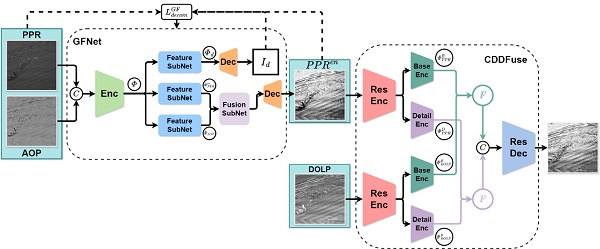
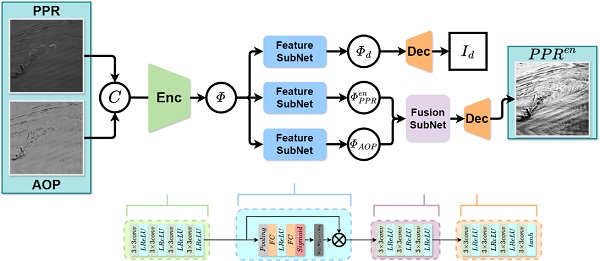
Previously, Researcher He Xianqiang innovatively put forward a new concept of ocean color polarization remote sensing based on Parallel Polarization Radiance (PPR), which has been proven effective in mitigating water surface glint effects. On this basis, this study integrates multiple polarization features including Degree of Linear Polarization (DOLP), Angle of Polarization (AOP) and Parallel Polarization Radiance (PPR) to construct the GFNet model, which greatly improves the detection and segmentation capability of water surface targets. Furthermore, the Correlation-Driven Feature Decomposition and Fusion (CDDFuse) network is introduced to establish the GF-CDDFuse target segmentation network. It separates and fuses low-frequency and high-frequency features, so as to effectively suppress the adverse impact of water surface glint on segmentation accuracy. (Fig.1 shows the algorithm structure of GF-CDDFuse model; Fig.2 shows the algorithm structure of GFNet model)
Pool verification experiments were carried out in this research, and polarization imaging data covering diverse scenarios with different weather conditions, time periods and solar altitude angles were collected. Experimental results indicate that the polarization-feature integrated GFNet achieves mean Intersection over Union (mIoU) values of 86.39 and 70.47 on mainstream segmentation models including KNet and FastSCNN respectively, which are remarkably superior to conventional methods. It verifies that glint suppression based on PPR can provide solid support for efficient segmentation of water surface targets.
For the first time, this study deeply integrates Retinex decomposition theory with polarization features, which effectively separates and eliminates complex light interference, and enhances the robustness and universality of small water surface target segmentation. The research outcomes can provide technical support for automatic monitoring of shallow, small and slow targets represented by UUVs as well as maritime safety early warning, and also open up new ideas for the application of polarization imaging and multi-modal fusion in remote sensing fields.
Fig.1 Algorithm structure diagram of the GF-CDDFuse model proposed in this study
Fig.2 Algorithm structure diagram of the GFNet model proposed in this study
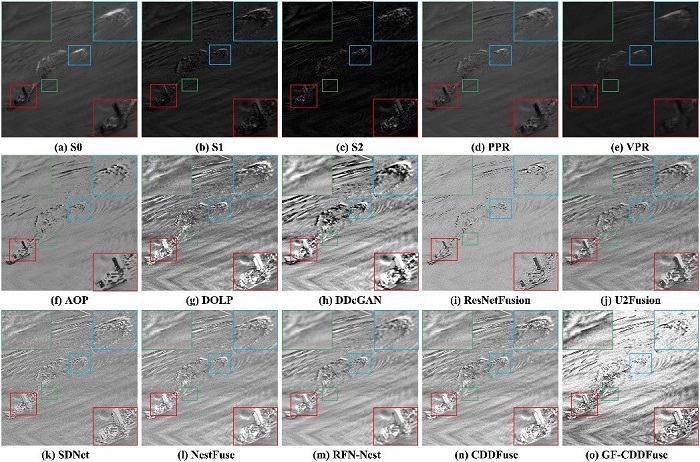
Fig.3 Visual quality comparison of 7 polarization parameters and 7 state-of-the-art (SOTA) fusion methods on images captured at 16:00 on January 30, 2024. Regions containing the UUV head, white foam and UUV navigation ripples are magnified in red, blue and green boxes respectively for clearer comparison.
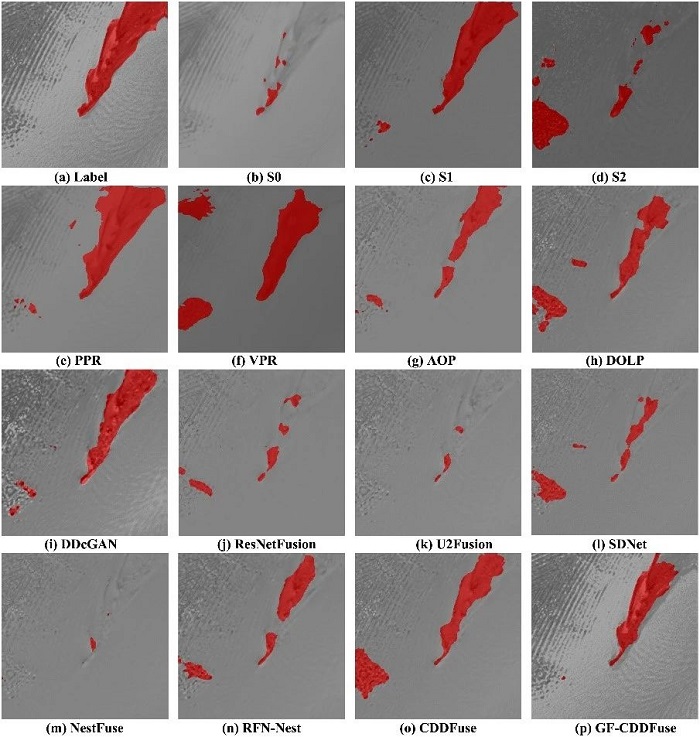
Fig.4 UUV segmentation results using 7 polarization parameters and 7 SOTA fusion methods based on the FastSCNN semantic segmentation model for images acquired at 13:55 on January 30, 2024. The UUV label is displayed in (a), where the UUV area is marked in red.
Paper Citation
Pan, T., He, X.*, Bai, Y., Shanmugam, P., Li, T., & Gong, F. (2026). Polarization-enhanced GFNet for glint-influenced water surface object segmentation. Expert Systems with Applications, 296, 128956.
Related References
[1] He, X., Pan, D., Bai, Y., Wang, D., Hao, Z. (2014). A new simple concept for ocean colour remote sensing using parallel polarisation radiance. Scientific Reports, 4(1), 3748.
[2] Pan, T., He, X., Zhang, X., Liu, J., Bai, Y., Gong, F., & Li, T. (2022). Experimental Study on Bottom-Up Detection of Underwater Targets Based on Polarization Imaging. Sensors, 22, 2827.